
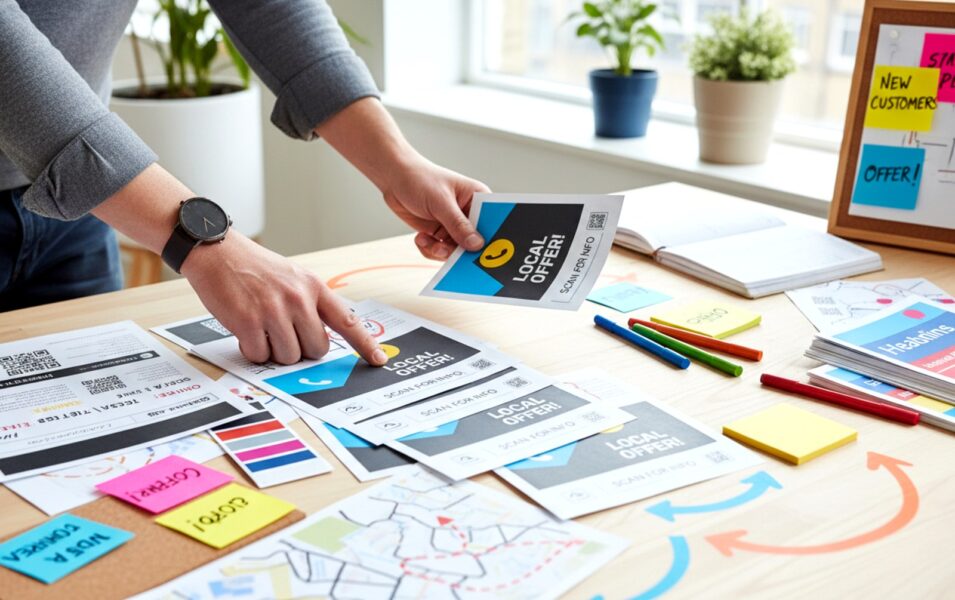
Leaflets That Pull Their Weight: Costs, Formats and Smart Ways to Distribute
Most leaflets don’t fail because of poor printing or bad design.
Those things matter, but they’re rarely the deciding factor.
Leaflets fail when there’s no clear offer, no urgency, and no obvious next step for the reader to take.
They might reach the right people at the wrong time.
But the biggest cause of failure is that they try to explain everything and don’t have a single, simple offer or call to action.
This guide is about making leaflets that earn their keep; the kind that prompt a response, not just a glance. Not perfect. Just effective.
We’ll cover how to define a clear goal, choose the right format and stock, control costs, and distribute leaflets in ways that actually get results; particularly for local campaigns in North Wales.
Sometimes, a neat design helps. Sometimes, “ugly” but clear wins.
What matters most is that the reader knows exactly what you want them to do next, and why they should do it now.
Start With One Outcome (Not a Design)
Before you think about size, paper, or graphics, decide one thing:
What do you want your reader to do after they’ve read your leaflet?
Examples:
- Book a table
- Scan a code
- Visit your shop
- Claim a local offer
Pick one action.
Everything else supports it.
A good leaflet has:
- One main message
- One clear call to action
- No competing priorities
If it needs explaining, it’s already too complicated.
Sizes and Formats: Choose What Suits the Job, Not What You’ve Always Used
In practice
- A6 – Cheap, disposable, easy to hand out. Best for events and short-term offers.
- DL – Good for menus, vouchers, racks, and anything you want kept in a pocket.
- A5 – The workhorse. Enough space to persuade without waffle.
- A4 – Too large for most leaflet use unless folded. It’s better when you need lots of information, such as menus, price lists, or guides.
- Folded – Ideal when content needs a clear flow, such as sections, steps, or categories.
Door drops?
A5 or DL usually gives the best value for money.
Paper, Eco Stocks and Finishes (What Actually Matters)
Paper doesn’t sell your offer, but it does signal intent.
- 130gsm: Cheap, flexible, fine for mass drops
- 170gsm–250gsm: More substantial to the touch. Helps reflect the value of higher-priced services and menus.
- 300gsm+: Only worth it if you are promoting a top-end product or service.
Eco options people might not notice, but still matter.
- Recycled, uncoated stocks
- FSC-certified paper
Finishes:
- Matt laminate: calm, understated, readable, less glare
- Gloss laminate: more visually striking, better for photos
- Soft touch laminate/foil/spot UV: only necessary if it suits the brand
If this is a short-lived promotion, don’t overthink it.
A lighter grammage (130gsm) coated stock often does the job perfectly well.
What Really Drives Cost (And What Doesn’t)
Prices move mainly because of:
- Quantity
- Turnaround time
- Paper weight
- Finishing
Jumping from: A5, 130gsm → A5, 350gsm + laminate + express delivery
will cost far more than doubling the quantity.
Rule of thumb:
Test cheap. Prove your offer works. Then and only then consider upgrading.
Budget guide: typical ranges
For typical A5, double-sided leaflets:
- 100–250 copies: Small spend. Ideal for testing
- 500–1,000 copies: Best balance of reach and value
- 1,500–5,000 copies: Lowest cost per unit, wider push
Expect 20–30% more for thick card or lamination.
Always factor in design and delivery time.
If you’d like more information on prices and quantity breaks, you can find out more here.
Test First. Guessing Is Expensive.
If you’re unsure:
- Print 250–500
- Change one thing per version (headline, offer, image)
- Track responses with a unique code or link
Then scale what works.
This is how leaflet marketing becomes predictable, not hopeful.
A Practical Guide to Writing a Design Brief
Keep it tight.
- Goal: one action
- Audience: define your who and where
- Offer: why they should care
- Call to action: phone, QR, visit
- Essentials: address, hours, services, contact information
- Assets: logos, images, colours
- Format: size, stock, finish
- Distribution: how it goes out
- Deadline: non-negotiable
Short copy wins.
Headline. Three points. One action.
Simple Design Rules That Improve Results
Best results will come from clarity, not cleverness
- One headline. Make it obvious.
- Body text at least 11pt.
- Dark text on light background.
- Leave space. White space is not waste.
- Use bullets, not paragraphs.
- Put the call to action at the top and bottom of the flyer.
Accessibility matters:
- Avoid light grey text.
- Avoid light coloured text on a dark background.
- Don’t rely on colour alone.
- Label icons clearly.
If you want a practical walkthrough of these principles in action, read our guide on How To Design A Flyer or Leaflet That Actually Gets Noticed.
Can you create a leaflet in Microsoft Word?
Absolutely. Yes, you can. Word is a perfectly usable design tool once you understand its limitations, but you must set up the document properly for print.
If you don’t have professional design software, many now start with Canva instead, as it’s quicker and more intuitive. Just be aware that your artwork still needs to be checked before sending it to print.
- Select the size required. Not A4 and hope that your printer will know it’s really an A5 leaflet.
- Add 3mm bleed all round if your design has ink to the edge. N.B. You cannot add bleed in Word like you can with Canva, so you’ll need to place content inside a safe margin and avoid edge-to-edge colour.
- Export to PDF at high quality.
- Use CMYK colour, not RGB.
Will it print well?
For basic layouts, yes.
For complex folds, tight colour control, and special finishes, professional design software works better.
Distribution Ideas That Actually Work in North Wales
- Door drops: nearby streets, trading estates
- Counters: cafés, gyms, salons, farm shops
- Events: markets, festivals, shows
- Inserts: newsletters, parcels, charity mailings
- Partner swaps: two non-competing local businesses share access to each other’s customer lists
The Simple Process (Use This Every Time)
- Decide one goal
- Choose size and stock
- Write short copy
- Design for clarity
- Add tracking
- Print small
- Test
- Scale
Repeat what works. Kill what doesn’t.
Final Thought
Leaflets still work, when they’re focused, tested, and well distributed.
Pound for Pound, they are still one of the most cost-effective methods of reaching your audience when you have a local promotion.
They fail when visual appeal is prioritised over function
- Keep them simple.
- Match the format to the job.
- Spend carefully.
- And always make it easy for people to act.
If you’d like to find out more, or talk to our team for friendly advice, please get in touch here.