
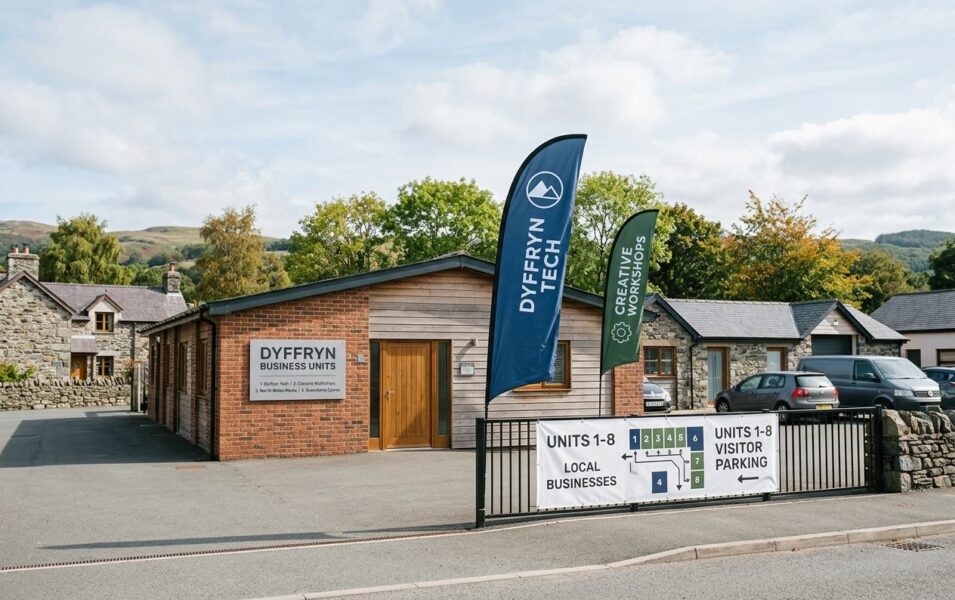
Outdoor signs and flags: choosing the right option without making life complicated
As if you didn’t know it, September is always a busy month.
The summer holidays are fading into the background, people are back at their desks, and plans that were quietly parked during August suddenly need a bit of a move on.
For many businesses, that means events, promotions, open days, refreshed shop fronts and new signage.
And with that comes a familiar set of questions.
What should the sign be made from? How big should the flag be? Will the artwork be good enough? And will it survive whatever the weather decides to throw at it?
So, rather than drowning you in a load of technical specifications, here’s a straightforward guide to some of the most useful outdoor print options.
You can also browse our full range of exhibition and display products if you want to see what else is available.
So, what exactly is Dibond?
If you’ve ever seen a beautifully flat sign fixed to the front of a building and wondered what it was made from, there’s a fair chance it was Dibond.
Dibond is an aluminium composite material. It’s rigid, relatively lightweight and very good at putting up with the British weather.
That makes it one of our go-to materials for permanent outdoor signage.
It works particularly well for door signs, car park signs, wayfinding, site boards, building names, and shop fascias.
For something that only needs to last a few weeks, there are cheaper options such as fluted board. But if the sign needs to stay looking smart for the longer term, Dibond is usually a very safe choice.
One of its biggest advantages is simply that it stays flat. That may sound obvious, but on a larger sign it makes a considerable difference.
How do you fix Dibond panels?
There isn’t one universal answer because it depends entirely on where the sign is going.
For most wall-mounted signs, screws with neat caps are perfectly adequate. Stand-offs can give a more contemporary look by holding the panel slightly away from the wall.
But if you want to fix your signs to posts, you can fit them with special clips and rails.
That spreads the load, cuts down movement and, importantly, stops your new sign rattling away every time the wind gets up.
What about flags?
Flags do something ordinary signs can’t: they move.
That movement catches the eye, which is why they work so well on pavements, forecourts, event routes and outside venues.
There are several different shapes available, but the choice needn’t be complicated.
Feather flags are tall and slender and work well where you want height without taking up too much ground space.
Teardrop flags have a more compact shape and tend to behave well in breezier locations.
Blade and crest flags give you a little more room for branding and are often used outside hotels, cafés, showrooms and events.
At the larger end of the scale, Wind Dancers can stand five or six metres high and are difficult to miss.
The important thing isn’t choosing from a bewildering list of dimensions. It’s choosing a flag that suits the location; after that, much of it comes down to personal preference.
It’s worth taking a little time to look at the location and work out what will suit it best. A huge flag squeezed onto a narrow pavement is no better than a tiny one disappearing into a vast forecourt.
You can see our full range of flags here.
Keep the message simple
It’s surprisingly easy to put too much on a flag or sign.
We see this quite often.
There’s a temptation to include the company name, telephone number, web address, email address, three services, a strapline, social media icons and everything bar the kitchen sink.
The trouble is, nobody is going to stop and read it.
Outdoor print usually works best when it has one job to do.
One logo. One headline. One clear action.
And make the important bits big.
A sign can be beautifully designed and beautifully printed, but if it’s too ‘busy’, no one will read it, let alone take the message on board. If it can’t do that, it hasn’t done its job.
A quick word about artwork
Large-format print can be forgiving in some ways and completely unforgiving in others.
A photograph that looks perfectly respectable on a laptop can become terribly blurred when it’s enlarged to six feet wide.
Logos can be even less forgiving.
Ideally, logos should be supplied as vector artwork. Photographs need to start with a good-quality original, and the artwork should always be created at the correct proportions.
For most large outdoor print, you don’t need the same resolution you would for a small brochure or business card because people generally view it from further away.
If you like the technical stuff, here are some rough figures:
- very large flags and arches can often work perfectly well at around 75–120 dpi at full size;
- fascias and larger boards are usually comfortable around 100–150 dpi;
- smaller signs viewed close-up benefit from higher-resolution artwork because fine detail is more noticeable at short distances.
Top Tip 1
Use vector files wherever you can. They aren’t memory hungry, and they’ll retain their sharpness whatever size you enlarge them to.
If that all sounds rather technical, don’t worry. We check artwork before anything goes into production and can usually tell very quickly whether there’s likely to be a problem.
Top Tip 2
We have artwork layout guides for all the flag types on our website, so please download what you need, you’ll find them a tremendous help.
And then there’s the wind
Our North Wales weather does occasionally provide us with some excellent product testing!
Flags are intended to move in the wind; that’s what they do. But they aren’t indestructible, and the stitching can begin to fray if exposed to extended periods of high winds
Use the correct weighted base on hard ground and a proper ground spike where the surface allows it. If the weather turns particularly lively, taking the flag down is considerably cheaper than buying another one.
Banners need similar common sense.
On exposed sites, mesh banner material can reduce wind loading because air passes through it rather than pushing against one large solid surface.
Whatever the material, use all the available fixing points. Leaving half the eyelets unused may save five minutes when you put it up, but it rarely saves anything in the long run.
You can see more about our bespoke vinyl banners here.
How long should outdoor print last?
That depends enormously on where it lives.
A Dibond sign securely fixed to a sheltered wall can remain in very good condition for years. If it faces direct sunlight, the colours will fade much faster than if it’s in shade or facing away from the sun. It sounds obvious, and sometimes it isn’t possible to reorientate a fixed sign, but it is worth bearing in mind.
A banner stretched across an exposed fence on a hilltop has a rather harder life.
Flags are the same. A flag used occasionally for events and stored properly afterwards will usually last much longer than one left outside permanently through every gale, frost and downpour. But beware of mice when they’re stored away. Keeping storage rodent-free can save many an anguished cry when flags and banners are brought out of storage to use again
The material matters, but so does the way it’s used.
Will my artwork be good enough?
Without seeing it, we can’t tell!
But if it isn’t, there’s usually something we can do to help.
The most common problems are low-resolution photographs, logos copied from websites and artwork created at the wrong proportions, and artwork with no bleed or trim.
Adding bleed or trim can usually be sorted out fairly easily, but designs taken too close to the edge have to be rectified in the original software. In other words, the person who designed it for you will have to do this.
So the earlier we see a draft, the easier it is to help you sort things out without a deadline breathing down everybody’s neck.
What size sign or flag do I need?
This is probably the hardest question to answer without seeing where it’s going.
Distance matters. Height matters. Traffic matters. Surrounding buildings matter.
Even the direction people approach from can make a difference.
That’s why we’d rather know a little about the location than simply sell you the biggest sign we can fit through the door.
A photograph of the site is often enough for us to point you in the right direction.
Ready for autumn?
Whether you need a simple site board, a new shop fascia, a row of flags for an event or something considerably bigger, the principle is much the same.
Choose the right material for the job, keep the message simple and make sure the artwork is up to it.
Do those three things and outdoor print can work remarkably hard for you.
And if you’re not quite sure what you need, send us a photograph of where it’s going, and we’ll help you from there.
If you’d like to find out more or talk to our team for friendly advice, please get in touch here.