What Does a Commercial Printer Actually Do? And How Do You Choose the Right One?
Let’s be fair, nobody gets particularly excited about ordering 5,000 leaflets or a box of business cards.
Well, perhaps we do, but then we’re printers!
For most businesses, printing is simply something that needs doing. You want it to look right, arrive on time and not become another job you have to worry about.
And if you need a little help along the way, you want someone who’ll answer your questions without making you feel as though you should have a degree in printing technology.
That, in a nutshell, is what a good commercial printer should do.
But there’s rather more to the job than simply putting ink on paper.
What does a commercial printer actually do?
At its simplest, commercial printers produce printed materials for businesses and organisations like yours.
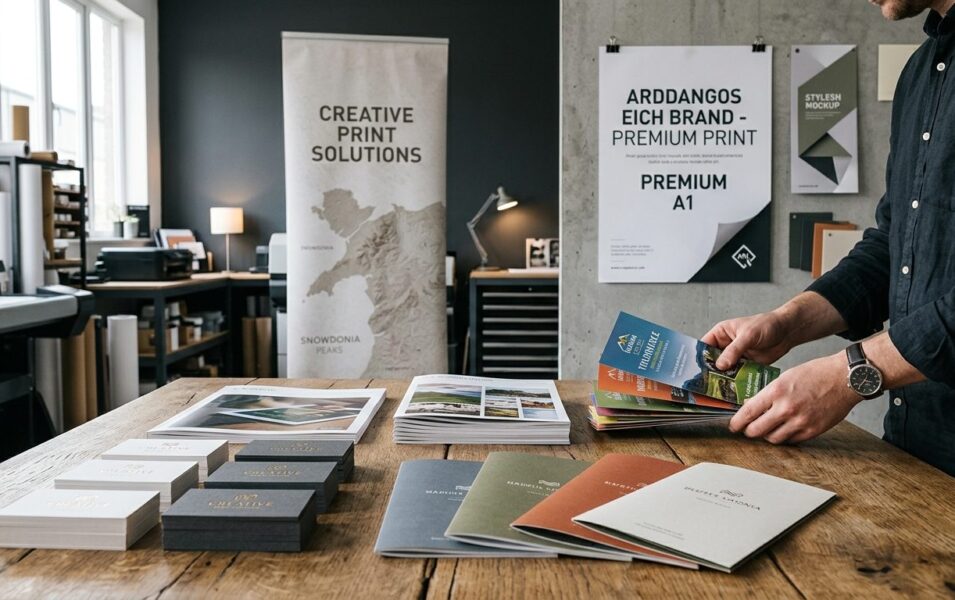
That might mean business cards, brochures, leaflets, posters, booklets, labels or a whole host of other items.
At Fineline Print & Web in Ruthin, we provide printing services for businesses across North Wales and beyond, from small, everyday jobs to large commercial printing projects.
We also produce large-format items such as vinyl banners, posters and roller banners for exhibitions, events and promotions.
But printing the job is only part of what we do.
Sometimes a customer knows exactly what they want. They’ve got their artwork ready, know which paper or material they’d like and simply need a reliable printer to produce it.
Other times, they’re not quite sure where to begin.
Perhaps they need a brochure but don’t know which paper to choose. Or they’ve got an event coming up and aren’t sure whether posters, banners or leaflets would work best.
That’s where being able to talk things through with someone who understands printing can make all the difference.
Our job is to help you arrive at the right result, not make the process more complicated than it needs to be.
Good printing starts with understanding what you need
One thing that came through very clearly in some customer research we carried out recently was how much people value being understood.
They don’t necessarily want a printer who offers them twenty different paper stocks and a bewildering selection of finishes.
They want someone who listens, understands what they’re trying to achieve and helps them make sensible choices.
And sometimes that means recommending something simpler or less expensive than the customer originally had in mind.
For example, a heavier paper isn’t automatically better. Neither is lamination always necessary. The right choice depends on how the printed item will be used, how long it needs to last, and what impression you want it to make.
Good advice at the start can save money, avoid disappointment, and make the whole process much easier.
What about all that printing jargon?
I’ll be the first to admit that the printing industry has more than its fair share of technical language.
Digital printing, litho, CMYK, GSM, bleed, finishing… It’s quite a collection.
Fortunately, you don’t need to understand all of it.
But here are a few terms that might be useful.
Digital printing is particularly suitable for smaller quantities and jobs with shorter lead times.
Lithographic printing is generally more economical for larger quantities, where the cost of setting up the press can be spread across thousands of copies.
Large-format printing is used for bigger items such as posters, vinyl banners and exhibition graphics.
GSM refers to the weight of paper. A 100gsm sheet is relatively lightweight, whereas a 350gsm card is a heavyweight board and feels much more substantial.
CMYK refers to the four printing colours: cyan, magenta, yellow and black.
Bleed is the little bit of extra artwork that extends beyond the finished (trimmed) edge of a printed item. We normally ask for 3mm so everything can be trimmed neatly, although large-format products like Vinyl Banners and Flags have larger trims.
Finishing covers everything that happens after printing, including trimming, folding, laminating, and binding.
There’s plenty more, but we’ll save that for another day!
The important thing is that you should feel comfortable asking questions. Nobody should be expected to understand the technicalities of an industry they don’t work in.
Getting your artwork right first time
This is one area where a little preparation can save a surprising amount of time.
We regularly receive artwork that looks perfectly good on screen but isn’t quite ready for professional printing.
Sometimes it’s a missing bleed, an image that’s too low-resolution, or a document set up at the wrong size.
And the worst culprit? AI-generated artwork, which often has key elements extending to the very edge of the page.
These things happen, particularly when people are preparing artwork themselves.
If you’re supplying your own files, here are a few things worth checking:
- Make sure your document is the correct finished size.
- Add 3mm bleed wherever colours or images extend to the edge.
- Use high-resolution images wherever possible.
- Prepare your artwork in CMYK.
- Embed your fonts and include crop marks in your print-ready PDF.
- If your job needs folding, make sure the folding arrangement is clearly specified.
We check supplied artwork for common technical problems and, if we spot something that could cause trouble, we’ll raise it with you.
Some adjustments are relatively straightforward. Others may require additional artwork time, but we’d always rather identify a problem before printing than discover it afterwards.
After all, nobody wants to open a box of freshly printed brochures only to find that something isn’t right.
If you’re preparing your own artwork and would like a little more guidance, we’ve put together a handy Artwork Guide that explains what we need and how to avoid the most common problems.
Choosing a commercial printer in North Wales
There are plenty of North Wales printers to choose from, not to mention the hundreds of online printing companies competing for your business.
So how do you choose?
Price is naturally important, but there’s something else worth considering.
How confident are you that your printer will do what they say they’ll do?
One customer summed this up particularly well in our recent research:
“If you say it’ll be done, I need to know it actually will be.”
I think that’s a perfectly reasonable expectation.
If you’ve organised an exhibition, booked a product launch or promised your sales team that their new brochures will be ready on Friday, you need to know you can rely on your printer.
And if there’s a problem, you need someone to tell you about it rather than leaving you wondering what’s happening.
Good communication matters
If you’d like to find out more or talk to our team for friendly advice, please get in touch here.