
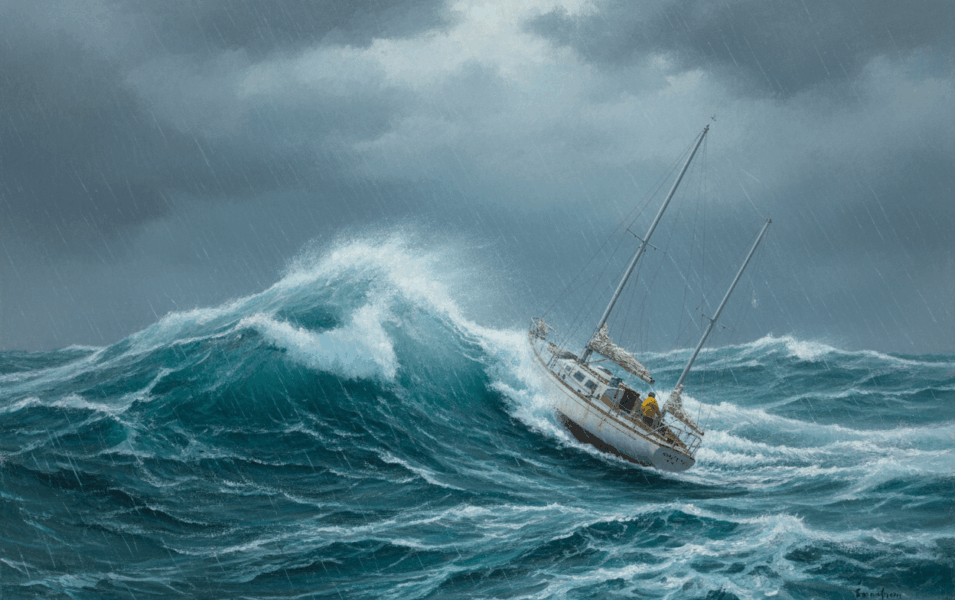
The moment most people would have quit …
Reaching Sydney Harbour on the 12th of December 1966 was a crowning achievement for Sir Francis Chichester.
But that was just half of it.
In just 107 days, he’d reached the halfway point of his attempt to sail around the world single-handedly.
Astonishingly, this was to be his only stop during his 226 days at sea.
Far from being able to celebrate, his boat was badly damaged, and he’d been battered mentally and physically.
Worse still, Gipsy Moth’s self-steering gear had been destroyed beyond repair.
Most people assumed the voyage was over.
To say that he needed a rest was an understatement.
Many looked at the situation with foreboding, and the press openly debated whether he should abandon the attempt.
Without hesitation, he set to work on the urgent repairs needed for the next leg of his perilous journey across the Pacific and around Cape Horn.
The trip around the Horn was every sailor’s worst nightmare. Chichester himself had said that the waves there were measured not in feet, but in increments of fear.
Nevertheless, six weeks and six days later, he was ready to go.
Slipping out of Sydney Harbour on the 29th of January, he declared, ‘I shall go on.’
119 days later, he sailed into Plymouth harbour to a hero’s welcome.
At the time, it set three records: the fastest solo circumnavigation, the longest non-stop passage by a small vessel, and the first true solo circumnavigation via the great capes.
Whilst this momentous achievement might have taken place 59 years ago, the lessons are profound.
It’s all too easy to throw in the towel when the going gets tough. But the prize often awaits those willing to push on when others would falter.
If you’ve got a project, event, or campaign coming up and you’d like the print side to look sharp and run smoothly, let’s talk.
Until next week!
Alec