Hardcover or Paperback: Which Is Right for Your Book?
So, you’re planning a book.
Maybe it’s a novel you’ve been working on for years.
Maybe it’s a history of your village cricket club or a keepsake for a family reunion.
Whatever it is, brilliant. One of the first decisions you’ll face is how it’s bound.
Hardback or Paperback?
It sounds like a small thing, but it shapes how your book feels the moment you pick it up.
It will affect how much it costs to produce, and whether it gets dog-eared on a commute or sits proudly on a shelf for decades.
Here’s what you need to know.
The Four Main Binding Types
There are four options you’ll come across. Each one suits a different kind of project.
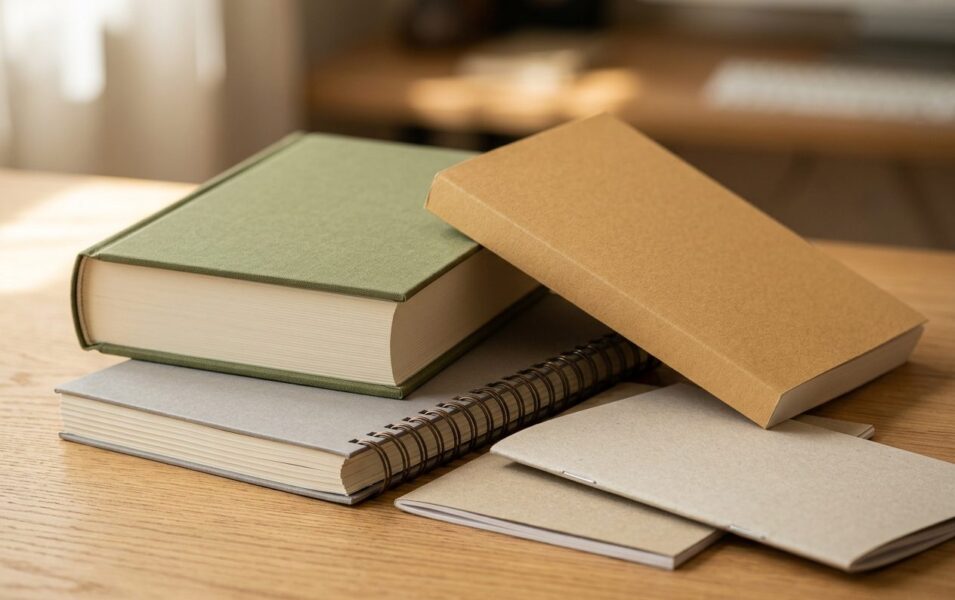
Saddle-stitched (stapled). Pages are nested together and stapled along the spine. Best for slim booklets, event programmes, and magazines, usually up to around 64 pages, depending on the paper. Sits fairly flat when open, and it’s one of the most cost-effective methods available.
Wire-o (wire bound). Holes are punched along the spine, and a wire loop is crimped in. It opens completely flat, which makes it ideal for cookbooks, instruction manuals, and workbooks where you need both hands free.
Perfect bound. The classic paperback. Pages are glued at the spine, a soft card cover wraps around, and you’ve got something that looks at home in any bookshop. Great for novels, memoirs, local histories, and catalogues.
Case bound. The hardback. The book block is glued or sewn, then fitted into thick boards, which are covered in printed paper or cloth. You can add a dust jacket, too. It’s the format that says this one matters — built to last and made to be kept.
In simple terms, saddle-stitch and wire-o are for slimmer or more practical titles. Perfect bound is your standard paperback. A case bound book is for something special.
How They Compare
Durability. Hardbacks win, full stop.
The board covers, and stronger construction take far more punishment. Paperbacks handle everyday reading well but will scuff and crease over time. Saddle-stitched and wire-o are built for their purpose, just not for long-term heavy use.
Look and feel. Hardbacks feel premium and giftable, you know it the moment you pick it up. Paperbacks are neat, professional, and practical. Saddle-stitched is tidy and simple. Wire-o looks purposeful.
Weight. Hardbacks are heavier because of the boards and endpapers. That matters if you’re posting signed copies or carrying stock to events. Paperbacks are lighter and cheaper to mail. Saddle-stitched is the lightest of the lot.
Unit cost. Hardbacks cost more per copy, and more on that in a moment. Paperbacks sit in the middle. Saddle-stitched is usually the most affordable, with wire-o somewhere between that and a paperback depending on size and page count.
Why Hardbacks Cost More
It’s not a mystery, there are simply more steps and more materials involved.
The board covers need to be cut, wrapped, and finished. Endpapers line the inside of the covers and bind the book block to the case. The spine usually needs extra lining for strength. There are head and tail bands for a neat finish. And if you add a dust jacket, that’s another printed piece to produce, trim, and fold.
Each of those steps takes time and skill. That’s reflected in the price. For a deeper look at the differences, we’ve written a simple guide on hardback versus paperback over on the Fineline site.
Short-Run Timelines – What to Expect
Short runs, typically 25 to 500 copies, are the most common route for local authors, self-publishers, and community groups. Digital printing makes this practical without the huge setup costs of traditional offset printing.
Saddle-stitched and wire-o are often the quickest, and we can turn around short runs in just a few days, depending on our workload.
Paperbacks take a little longer because of the binding and curing process. Once proofs are approved, a short run typically completes within 1 to 2 weeks, depending on the required run length.
Hardbacks need the most time. Case-making, sewing (if required), binding, and any dust jackets, all of which add days to the process. We would recommend that you build in more lead time than you would for a paperback.
One thing to flag early: if you’ve got a launch event, a book fair, or a specific date in mind, say so upfront. It shapes the advice you’ll get on the best route to take.
Does the Content Change Between Formats?
No. The words, images, and layout inside the book are exactly the same unless you actively choose to add extras. A hardback might include a dust jacket, printed endpapers, or a ribbon marker. A paperback can have a special laminate finish, but the story doesn’t change unless you update the file.
When to Choose a Paperback
Go paperback if you need a lower unit cost to keep your retail price competitive, lighter parcels to cut down postage, something easy to carry to markets and book signings, or a faster turnaround for a launch or tour.
When to Choose Hardback
Go hardback when you want something special. They’re the go-to option for gift editions, school or club milestones, family history keepsakes, and any title that’s going to pass through many hands over many years.
File Setup: Getting It Right Before You Print
This is where projects can so easily run into trouble, so it’s worth taking five minutes to check these before you send anything over.
Set your page size to the exact final trimmed size, not A4 if your book is A5.
Use CMYK colour mode throughout. Add 3mm bleed on any side where an image or colour reaches the edge.
Then run through this list:
- Export a print-ready PDF with fonts embedded or outlined
- Images at 300 dpi minimum at their print size — low-res files are one of the most common causes of reprints
- Keep key text at least 10–15mm from the trim edge; allow more at the spine for thicker books
- Include crop marks outside the bleed area
- Name your files clearly, project name, version number, binding type
If you’re also producing any folded leaflets to promote the book, note the fold type at the point of order. For tri-folds, be specific: Z-fold or roll fold. It helps to put it in the file name too. Something like: SpringLaunch_A4_trifold_Zfold_v2.pdf
You can learn more about file preparation from our guide here.
How Proofs Work
A proof is your safety net. Please, don’t skip this step.
We’ve never once heard someone say they regretted asking for one.
Most commonly, you’ll receive a digital PDF proof to check page order, margins, bleeds, image quality, and spelling.
We are rarely asked for a printed proof, but if you do wish to receive one, please allow extra time for a physical mock-up. A week would be a reasonable time for a paperback book, whereas a fortnight or more may be required for a case-bound book.
Top Tip. Printed copies are expensive, so don’t opt for one unless your budget allows. If your printer offers you the opportunity, sitting down with them when you choose the paper and binding method should be all you need to make an informed choice.
Approve only when you’re genuinely happy. A small text shift near the spine can look very different in print than it does on screen. Proofs may add a few days, but they save a lot of headaches and can save a great deal of money should a print run need to be junked.
A Note on Weight and Postage
It stacks up faster than you’d expect. A hardback A5 with 200 pages can weigh half as much again as a paperback of the same size.
So build that into your budget if copies are to be sent by mail.
Quick Prep Checklist
- Page dimensions set to final trimmed size ✓
- 3mm bleed added ✓
- CMYK, fonts embedded or outlined ✓
- Images at 300 dpi minimum ✓
- Margins: 15mm+ from trim edge ✓
- Allow for wider margins in the centre ✓
- Print-ready PDF with crop marks ✓
- Files named clearly with version number ✓
- Binding choice and quantity confirmed ✓
FAQs
Is hardcover or paperback better?
It depends on what the book is for. Gifts, libraries, and keepsakes, we’d recommend a hardback every time. Where budgets are paramount, a paperback is your best choice.
Why is a hardback book more expensive?
More materials, more steps. Boards, endpapers, extra spine lining, head and tail bands, each one adds to the unit cost.
Is there any difference in the content?
No. The layout and text are identical unless you specifically add extras like a dust jacket or printed endpapers.
Can I release both formats?
Absolutely. Some authors do both at once by ordering a very short run of hardback versions for very select distribution and paperbacks for the main run.
Fineline Print is based in Ruthin, Denbighshire, and works with authors, clubs, and community groups across North Wales, Cheshire, and beyond. Whether you’re looking for printing services in North Wales, business card printing, or poster printing, the team is happy to talk through what suits your project and your deadline.
And if you are unsure what you need, that is perfectly normal, too. That is where we come in. We’re here to help – that’s what we do.
If you’d like to find out more, or talk to our team for friendly advice, please get in touch here.